Agility's SEC filings put a humanoid at $100,000 a year
Agility's go-public filings show what a working humanoid costs: about $100,000 a year per robot, with a 50-robot minimum. The vote is November 2.
The SEC declared Agility Robotics' merger registration effective on October 13, clearing the Oregon humanoid maker to go public through Churchill Capital Corp XI. Shareholders vote on November 2, and the combined company expects to trade on Nasdaq as AGLT.
The listing is the news. The more useful part is what Agility had to put on the public record to get there. Going public means the pricing of a working humanoid is now in an SEC filing instead of a sales deck, where anyone pricing automation can read it.
The numbers
The detail comes from the transcript of Agility's October 6 investor day, which Churchill filed with the SEC as a Form 425. Agility's CFO, Michael Beer, laid out the rental model: customers pay an annual subscription plus a deployment fee of about $25,000 per robot. Averaged over 5 years, Agility puts that at about $100,000 per robot per year.
The order book checks out against that figure. Agility's chief business officer, Daniel Diez, said the $300 million in committed Digit 5 orders comes from a single customer, covering 1,000 robots on 3-year contracts. $300 million across 1,000 robots and 3 years is $100,000 per robot per year.
Other figures from the same filing:
- Agility's illustrative labor benchmark is a fully burdened $30 an hour, about $180,000 a year in labor cost. That works out to roughly 6,000 hours, close to 2 full shifts.
- Building a Digit 5 costs about $150,000 in parts at launch, with a target near $30,000 once the factory runs 10,000 units a year.
- The entry program asks for use cases of at least 50 robots, a minimum opportunity of about $25 million over 5 years, and about $500,000 to take part.
- Deployment commitments stand at 9 customer facilities, with a target of up to 25 by the end of 2027.
The S-4 press release adds that the deal is expected to bring in more than $620 million in gross proceeds, including about $200 million from a stock sale led by Foxconn, and that earlier Digit models have logged more than 65,000 hours of real work.
Why the battery deal matters to the math
On October 15 Agility named Nyobolt as the battery supplier for Digit 5: 90 minutes of work on a 9-minute charge, which Agility says is more than 20 hours of work in a 24-hour day. That is the number the $100,000 depends on. Agility is pricing a robot against close to 2 shifts of labor, and a robot that sits on its charger half the day cannot carry that comparison. Its own release lists Nyobolt as the exclusive battery provider and names that as a risk, which is the honest reading of a single-supplier part on a brand-new product.
What this means for a building in Utah
Start with the 50-robot floor. A humanoid from Agility is not a purchase a single building makes. It is priced and contracted like a fleet for a distribution center that runs 2 or 3 shifts, and early access does not begin until the first half of 2027, with general availability set for the end of that year. If you run a 100,000 sq ft warehouse in West Valley or a plant in Ogden, this is a 2028 conversation at the earliest.
What does carry over is how the pricing is built. Agility does not sell a robot. It sells hours of a specific job, tote handling, against an hourly labor rate. That is the right way to think about any robot in a building. Work out which job eats the hours, what an hour of that job costs you fully loaded, and how many hours a day the machine can actually run before it needs a charge or a person.
For a lot of buildings, the job eating the hours is not one that needs legs or hands. It is pushing carts between a dock and a line, or scrubbing the same 40,000 sq ft every night. Single-purpose robots do those jobs at a very different price point. Our Pudu T300, which hauls up to 661 lb between stations, is $20,000 cash, plus RoboCare at $200 a month. It cannot pick a tote off a shelf. A humanoid can. The question is whether that skill is where your labor actually goes, and most facilities will find the walking and the floors come first.
What to watch
The November 2 vote, and how many Churchill shareholders redeem rather than stay in, which decides how much of the $620 million actually arrives. Then the first half of 2027: whether Digit 5 reaches early access customers on schedule, and whether the 9 committed facilities become the 25 Agility is promising. A rental price set at launch is a public number now, so watch whether it holds.
Robots in this story, sold and serviced from Provo: T300 and T600 industrial delivery
Sources
- Churchill Capital Corp XI, Form 425, Agility Analyst and Investor Day transcript
- Churchill Capital Corp XI, Form 8-K press release, October 13
- Agility Robotics, S-4 declared effective, October 13
- Agility Robotics, Nyobolt battery partner for Digit 5, October 15
- SEC EDGAR, Churchill Capital Corp XI filing index
Want to see one of these working?
We are a Utah robotics implementation company. Our own technicians install and service every machine we sell.
Book a walkthroughMore robotics news
Pudu's robot elevator controller earns CSA safety certification
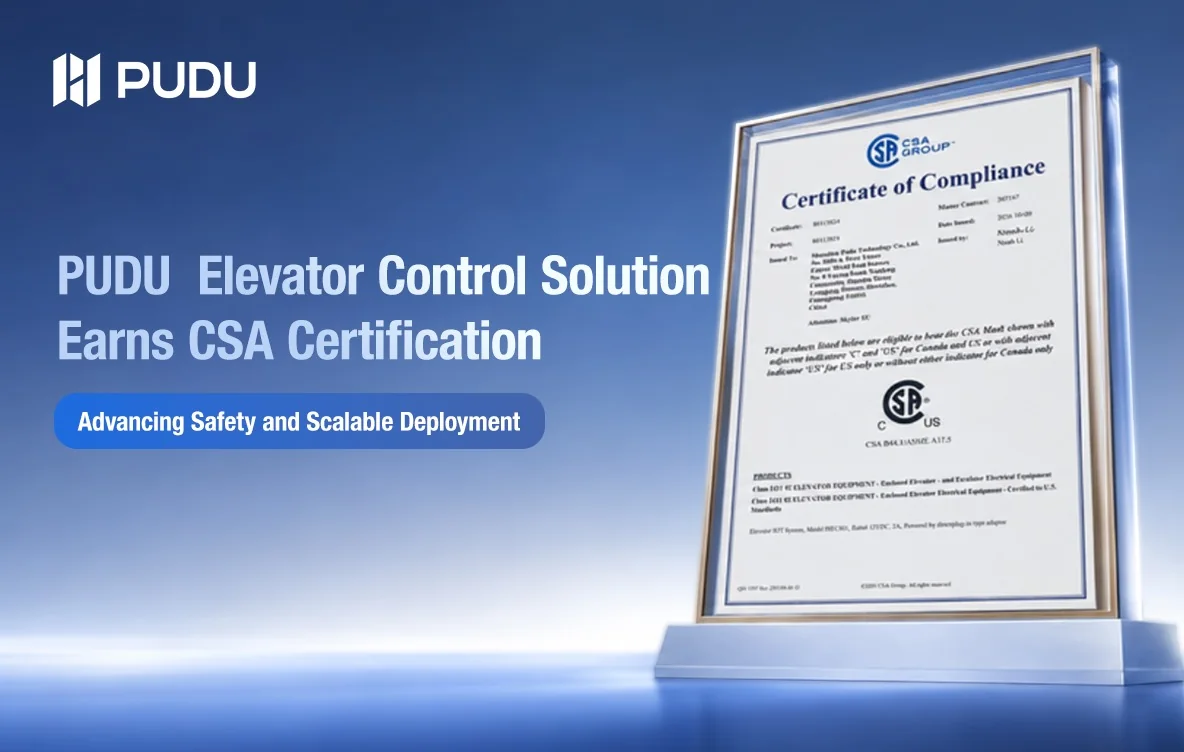
Pudu says the box that lets its robots call elevators is now certified to CSA B44.1/ASME A17.5, the North American elevator electrical standard.
Tesla starts Optimus production with no price or delivery date
Tesla says Optimus production began in Fremont on lines built for 1 million robots a year. Its filings give no price and no date for outside buyers.
Tennant's first robot vacuum was tested in a school district
Tennant launched the P1 VAC on October 20, a 101 lb robot that vacuums, sweeps and dust mops, with 3.5 hours of runtime. A Wisconsin district tested it.