A wall-finishing robot raises $20M as crews run short
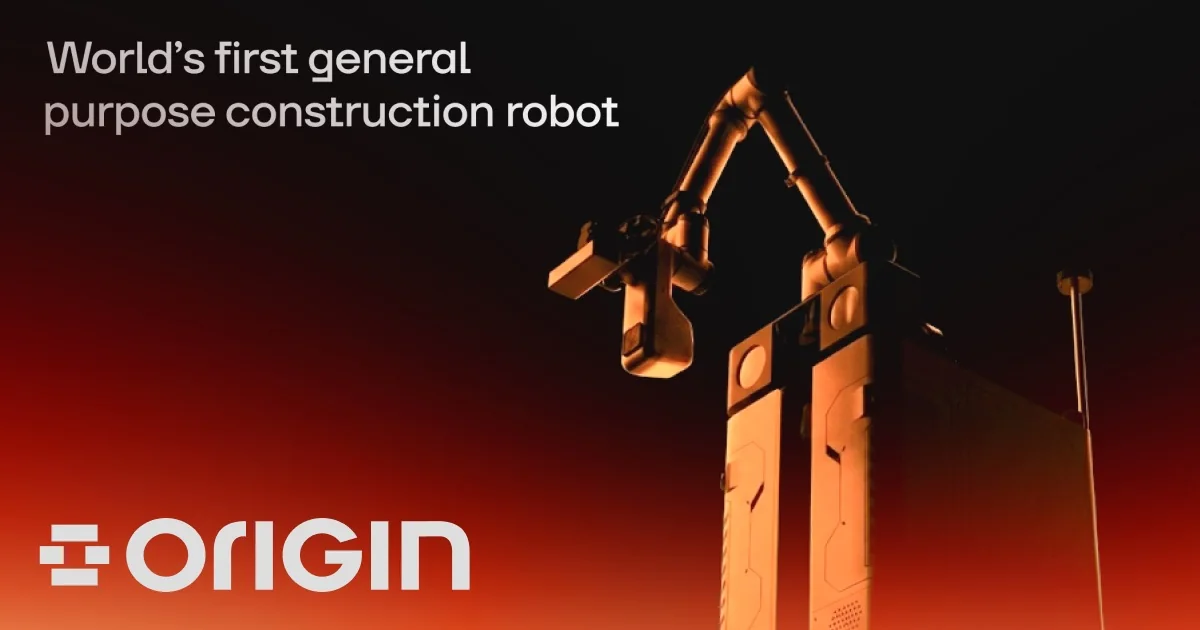
Origin came out of stealth on October 15 with $20M for OG-1, a robot that applies compound, sands and primes walls up to 14 ft. It wants 150 deployed by 2027.
A San Francisco startup called Origin came out of stealth on October 15 with $20 million in total funding, co-led by Accel and Zacua Ventures. Its robot, OG-1, does the part of interior construction most people never think about until it is late: applying joint compound, sanding it and priming the wall.
Origin says the robot is already working on job sites in commercial space, apartments, data centers, hotels and warehouses, and that it wants 150 of them deployed by the end of 2027.
The numbers
From Origin's announcement:
- OG-1 finishes walls up to 14 ft high, on a 3-wheeled base with a 360-degree view, and uses real-time force control to keep sanding pressure even.
- It is built to work next to active crews without a cordoned-off area.
- The first robots went onto New York job sites within 10 months of the company's founding in early 2025.
- Pilots are running with 2 of the largest drywall finishing contractors in the US, with more planned in Germany, Sweden, France and Saudi Arabia.
- Next on the list are taping, drywall installation, drilling and conduit.
The CEO, Yogesh Ghaturle, says the robots are "already working at three times human speed, delivering human-level quality." That is the company's own claim, and nobody outside Origin has published a number to check it against. Treat it as a target to ask about, not a spec.
The money makes more sense next to the labor data. In the Associated General Contractors' 2026 workforce survey, 42% of respondents said worker shortages had delayed projects, the most common cause of delay named. 74% reported at least one significant delay in the past year, from 1,830 respondents.
Utah is no easier. AGC's Utah results come from only 22 firms, so read them as a signal, not a census. Of those, 86% had open hourly craft positions, 41% said worker shortages were delaying projects, and 83% expect to add headcount in the next 12 months.
And robots are still a rounding error on the job site. Zacua Ventures' 2026 report counts $1.36 billion of venture money going into construction robotics in the first 3 quarters of 2025, against $612 million in all of 2024. It also puts robots at less than 0.03% of global construction spend, and calls drywall finishing "pilot-to-early production today."
What this means for a building in Utah
If you own or run a building, you are not going to buy one of these. Your general contractor's drywall sub might, and that is where it would show up for you: on the schedule of a tenant improvement, a hotel renovation or an apartment turn.
Finishing is the stretch of a build-out where a short crew hurts most, because it is repetitive, it runs in coats with drying time between them, and nothing after it can start until it is done. When a sub is a finisher short, the ceiling grid, paint and flooring all wait. A machine that can keep sanding and priming on the plain walls is aimed squarely at that bottleneck.
The 14 ft reach is the practical limit to note. Most office suites, classrooms and apartments fall under it. Lobbies, gyms, retail boxes and warehouse offices with tall walls do not, and those walls still need lifts and people.
If a contractor proposes robotic finishing on your project, the useful questions are plain ones. Who supervises the machine on site, and is that person on the sub's crew or the robot company's? Does the finish get inspected to the same level in your spec, by the same person, as hand work? Is it sanding during hours when tenants are in the building? Does the schedule actually come in shorter, and is that in writing?
We sell cleaning and service robots, not construction robots, so we have no stake in this one. But the pattern is the one we see on floors. The robot takes the large, plain, repeatable areas. People keep the edges, the odd shapes and the judgement calls. The win is not a crew of zero. It is a smaller crew covering more wall, in a market where the next finisher is hard to hire.
What to watch
Origin has put a number on the board: 150 robots by the end of 2027. Whether it gets there, and whether either of the 2 big finishing contractors moves from pilot to a fleet order, will say more about this category than the funding round does. The other thing to watch is an independent figure on speed and finish quality from a contractor, not from the company. Until one appears, the 3x claim stays a claim.
Sources
Want to see one of these working?
We are a Utah robotics implementation company. Our own technicians install and service every machine we sell.
Book a walkthroughMore robotics news

Pudu's robot elevator controller earns CSA safety certification
Pudu says the box that lets its robots call elevators is now certified to CSA B44.1/ASME A17.5, the North American elevator electrical standard.
Tesla starts Optimus production with no price or delivery date
Tesla says Optimus production began in Fremont on lines built for 1 million robots a year. Its filings give no price and no date for outside buyers.
Tennant's first robot vacuum was tested in a school district
Tennant launched the P1 VAC on October 20, a 101 lb robot that vacuums, sweeps and dust mops, with 3.5 hours of runtime. A Wisconsin district tested it.