San Jose gives a stuck delivery robot 30 minutes to move
San Jose's council took up delivery robot rules on October 6 with a $200 permit per robot, a 5 mph sidewalk limit and 30 minutes to clear a stalled one.
On October 6 the San Jose City Council took up a package of rules for delivery robots: a new chapter of city code, a permit fee for every robot, and a schedule of fines. San José Spotlight reported that it passed unanimously, with 2 members absent. The city's own record had not posted the final action when we checked.
Until now San Jose had nothing on the books. The staff memo says so plainly: 2 companies, Coco Robotics and Serve Robotics, were already running sidewalk robots, and there were no rules prohibiting them or governing how they operate.
The numbers
Most of the detail sits in draft administrative regulations that the transportation director approves and can change without going back to council. As proposed:
- $200 a year per sidewalk robot, and $250 per robot for a 1-year pilot of larger machines in bike lanes
- A $10,000 deposit from each operator against damage, impound costs and fines, written into the ordinance
- 5 mph on sidewalks, pedestrian paths and crosswalks, for robots the memo says can do about 10 mph
- 30 minutes to remove a robot that is breaking the rules or has broken down, or the operator is fined
- Fines of $100, $200 and $500 for a first, second and third offense
The city expects about 70 sidewalk robots and 30 bike lane robots. That is $21,500 a year in fees, which staff say covers 21.9% of the $98,292 it will cost to run the program.
The rest is about being seen and heard. Lights on at all times and visible from every side. A sound while moving. A tall flag on anything shorter than 46 inches. An ID number and a contact on every robot, which the council presentation says must also be in Braille and raised letters. A robot waiting on an order has to sit in the strip of sidewalk where the meters and trees are, not in the walking path.
There is no cap on the number of robots. The city reserves the right to add one.
The bike lane robot
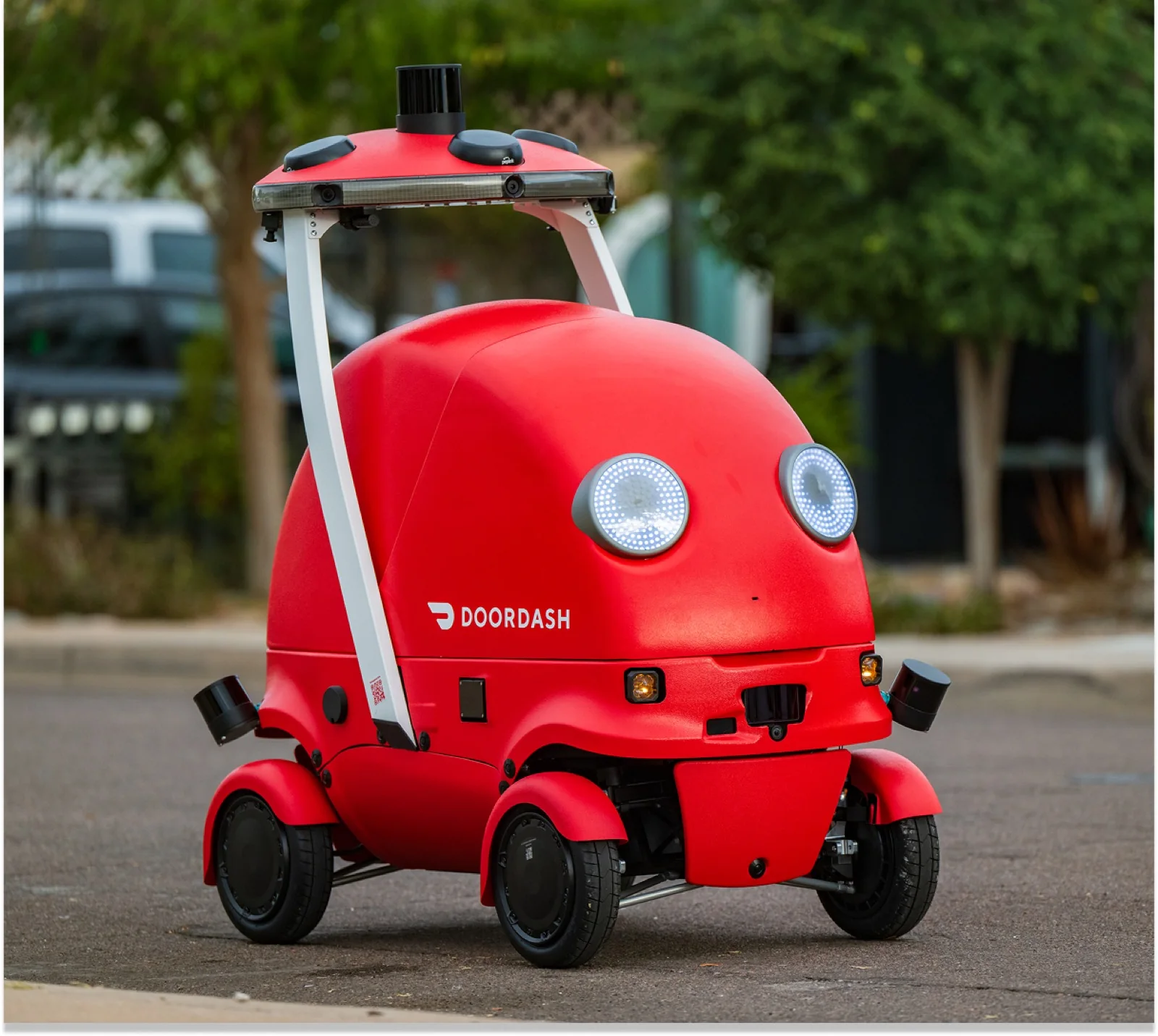
The pilot is written around one machine. DoorDash's Dot is nearly 5 feet tall, 3 feet wide, and reaches 20 mph. The memo calls San Jose DoorDash's largest city deployment to date.
Dot gets no fixed speed limit in a bike lane. It has to match a slower cyclist ahead, yield to a faster one behind, drop to 5 mph at protected intersections and never park in a bikeway. Staff will report back after 9 months on whether to keep it, extend the pilot or take it off the road.
Who answers for a robot that blocks a ramp
The disability sections are the part worth reading twice. The memo names the hazard directly: a robot that blocks a sidewalk, curb ramp or crosswalk, or that someone who is blind does not expect to find there. In June, staff met with leaders from the California Council of the Blind and the Silicon Valley Council of the Blind.
The ordinance then puts the bill on the operator. A permit requires the company to indemnify the city against claims, and the text specifically includes alleged ADA violations caused by where a robot was placed. Staff are candid about the limits:
The regulations seek to minimize hazards, but they cannot eliminate them.
What this means for a building in Utah
Utah wrote its statewide rule in 2020. Utah Code 41-6a-1119 lets a delivery robot run at 10 mph in a pedestrian area, twice San Jose's limit, with $100,000 in liability coverage. It sets no permit fee, no deposit and no deadline for moving a dead robot. The statute leaves that to cities, which may "reasonably regulate" after talking with the operators. San Jose is a look at what a city writes once the robots are already on its sidewalks.
If you own a plaza, a shopping center walkway or a campus quad, read one definition closely. San Jose's rules cover any outdoor area open to the public, "whether owned or operated by the City or a private party." A Utah city could draw the same line. Your sidewalk may be inside the rule even though it is on your parcel.
The indoor machines we sell, like the FlashBot delivery robot and the CC1 scrubber, never touch a public sidewalk, so none of this applies to them. The question behind it does. The ADA Standards require 36 inches of clear width on an accessible route, and a robot stalled in a corridor or parked at a charger takes its space out of that.
So write your own 30-minute rule before the robot arrives. Decide who gets the alert, who walks over, and where the machine waits and charges so the route stays open. San Jose had to put that in an ordinance. Inside your building it is one paragraph in the site plan.
What to watch
Watch for the final regulations and the first fine. Watch the 9-month report on bike lane robots, because other cities will copy whatever San Jose concludes. And watch whether a Wasatch Front city writes a removal clock of its own before a fleet is on its sidewalks, or after.
Robots in this story, sold and serviced from Provo: FlashBot multi-floor delivery · CC1 Pro floor scrubber
Sources
- City of San José, File 26-1033, Regulation of Personal Delivery Devices
- City of San José, Department of Transportation memorandum, September 14
- City of San José, draft ordinance adding Chapter 11.91
- City of San José, resolution amending the schedule of fines
- City of San José, October 6 council presentation
- San José Spotlight, report of the council vote
- DoorDash, Dot announcement
- Utah Code 41-6a-1119, personal delivery device
- US Access Board, ADA Standards chapter 4, accessible routes
Want to see one of these working?
We are a Utah robotics implementation company. Our own technicians install and service every machine we sell.
Book a walkthroughMore robotics news

Pudu's robot elevator controller earns CSA safety certification
Pudu says the box that lets its robots call elevators is now certified to CSA B44.1/ASME A17.5, the North American elevator electrical standard.
Tesla starts Optimus production with no price or delivery date
Tesla says Optimus production began in Fremont on lines built for 1 million robots a year. Its filings give no price and no date for outside buyers.
Tennant's first robot vacuum was tested in a school district
Tennant launched the P1 VAC on October 20, a 101 lb robot that vacuums, sweeps and dust mops, with 3.5 hours of runtime. A Wisconsin district tested it.